The program is not perfect but it's still very good:
1) the program has much more options and is much more configurable,
2) the program is much less burdening for the computer.
Please notice that I still regularly use the website, especially when I want quick results, better visuals or deeper star field.
When I am using the website on an old laptop I can hear the CPU fan working very hard, but I don't have this problem with the program on the same laptop. The program is even less burdening for the computer when you change the frames per seconds (fps) in the config file (more on that at the end of the post).
There are tons of options in the program, but the most important thing is the fact that I can simulate light pollution for the exact time of my planned observations (to simulate light pollution on the website I had to set the time for twilight hours – for much earlier time).
Please notice that while simulating light pollution EVERYTHING that I can actually see in reality looks better than in the program! More shiny and more impressive! The program is good at simulating WHAT you can see, NOT how you can see it!
To achieve a satisfying effect in the program I have to use these four options together (they are all under the “Sky” tab):
1) Sky – Light pollution,
2) Stars – Absolute scale (influences also planets and moons),
3) Stars – Relative scale (influences also planets and moons),
4) Stars – Limit magnitude.
To explain why I use a particular configuration of the settings above I have to show you some examples that introduce changes step by step.
Please open all pictures in separate tabs and switch back and forth between the tabs to see the differences better.
Light pollution 1 (smallest), Absolute scale 1 (default), Relative scale 1 (default) and Limit magnitude turned off (default):
As you can see the brightest stars are unnaturally big! This is the way classic (paper) sky-charts show magnitude of stars – by their size. This is also the way the Stellarium website shows the night-sky. Fortunately in the Stallarium program we can make the view more natural.
Light pollution 1, Absolute scale 1, Relative scale 0.5 and Limit magnitude turned off (“my default” setup):
Now the brightest stars look much more natural AND there are actually MORE stars visible overall! I saved this combination as “my default” setup.
The Milky Way is still visible, but from my balcony I can't see it at all, so I have to turn it off.
Light pollution 4, Absolute scale 1, Relative scale 0.5, Milky Way turned off and Limit magnitude turned off:
This view is already quite depressing, but there are still too many stars visible! From my balcony I can't see “so many” stars, even though light pollution in my home city is “only” Bortle class 6, probably because there are many street lamps near my balcony that are blinding me directly.
Light pollution 4, Absolute scale 0.25, Relative scale 0.5, Milky Way turned off and Limit magnitude turned off:
This combination of settings almost perfectly simulates what stars I can see from my balcony with the naked eye (when the field of view is extremely big) and with 8x42 binoculars (when the field of view is still bigger than in any telescope).
Please notice also that the stars that I can actually see in reality look better than in the program! More shiny and more impressive! The program is good at simulating WHAT stars you can see, NOT how you can see them!
Please notice that there are hardly any stars visible in the naked eye, but when I zoom in more and more stars appear, just like in real life – even the weakest binoculars allow you to see much more stars even in big light pollution!
However when I zoom in to a field of view typical for a small telescope, for example 1.9 degrees there are some “extra” stars in the program that I can't see in my telescope.
If you are interested, the value of 1.9 degrees was calculated this way: 700 mm telescope / 25 mm eyepiece = magnification 28x; typical apparent field of view of eyepieces is 52 degrees, so the field of view is equal to 52 degrees / magnification 28x = 1.9 degrees.
Light pollution 4, Absolute scale 0.25, Relative scale 0.5, Milky Way turned off and Limit magnitude turned off (the same combination as previously, but the field of view is now very small and the view centers at a different place):
From my balcony I can't see “so many” stars in my telescope, so I have to trim the “extra” stars further down. On several occasions I verified that from my balcony in my telescope the limit magnitude is around 9.0 (this value would be different for another telescope and/or for another observatory point).
Light pollution 4, Absolute scale 0.25, Relative scale 0.5, Milky Way turned off and Limit magnitude 9.0.
This combination of settings almost perfectly simulates what stars I can see from my balcony in my telescope in big magnifications. Please notice also that the stars that I can actually see in reality look better than in the program! More shiny and more impressive! The program is good at simulating WHAT stars you can see, NOT how you can see them!
The problems, as always, are with globular clusters, galaxies and nebulas. They are very sensitive to light pollution and it's impossible to predict what can be seen from a particular observatory point in a particular telescope. In the program there are photos of such objects incorporated into the view, but they always appear better than in my binoculars or in my telescope (in a given field of view). There's no combination of settings that simulates what I can see when I look at such objects.
In the program Stellarium there are additional problems with globular clusters and with galaxies that are non-existent on the website.
In the program there are photos of globular clusters instead of actual stars, while on the website there are hundreds of separate stars that on their own build proper pictures of globular clusters (without any photos). When you set the time to an early hour in the program the photos fade and stop being visible, while on the website you can see all the stars as tiny points.
What's worse in the program within globular clusters there are some stars visible that are NOT actually THERE!!! This is ridiculous! Here's the globular cluster M13 in big magnification (around 65x):
Do you see the 2 stars inside the cluster? Here's the same place after I turned off the option “Deep-sky objects background images”:
In the program these “stars” have no name and they are of magnitude 8.05 and 8.40, but in reality there are NO such stars! On the net I found this info: “M13 is composed of several hundred thousand stars, the brightest of which is a red giant, the variable star V11, also known as V1554 Herculis,[12] with an apparent visual magnitude of 11.95”.
I think that the same problem concerns galaxies – in the program in the heart of the Andromeda galaxy I found two “stars” that I think are not actually there, but I'm not completely sure. Let's focus on the M13.
When I turned the Limit magnitude off more stars appeared, but NOT in the center of the cluster!
So, in the program the cluster looks like a donut! This is probably why the button for the option “Deep-sky objects background images” isn't visible by default.
If you are interested, this button can be activated in the file config.ini that can be usually found in the folder …\AppData\Roaming\Stellarium. You have to set the value “true” in the line “flag_show_nebulae_background_button”.
In the same file you can also make one crucial change – you can set a constant value for frames per second. When the maximum value for FPS is low enough then the program is even less burdening for the computer processor. When the minimum value for FPS is high enough then there is no “stuttering” while using the program. Personally in the lines “maximum_fps” and “minimum_fps” I set the same value 7.
Even thought the program has some flaws it's VERY good and on some levels it's better than the website! What a treasure!
(Originally posted on Saturday, 10 April 2021)
After I wrote this post: Most universal types of binoculars
I started to think about buying a small telescope, but I was not quite sure. And then I stumbled upon a TV programme about history of modern astronomy that made me make up my mind. I simply wanted to feel as an astronomer, no matter how poor equipment I would have!
This TV programme (“Ancient skies - Our Place in the Universe”) is by far the most fascinating TV programme about the history of modern astronomy that I have ever seen! It can't be embed and has to be watched here: https://www.facebook.com/AncientSkiesPBS/videos/ancient-skies-our-place-in-the-universe/180671763358209/
It's the third part of the series “Ancient skies”. This part starts after Mikołaj Kopernik (Nicolaus Copernicus) “stopped the Sun and moved the Earth” and this is why I call it “modern history”. However there were some other things that were still totally misunderstood then – for example people thought that the planets orbited the Sun moving in perfect circles (instead of ellipses). Another very good example is the fact that even in the early 20th century people, including Albert Einstein, thought that the universe was static (instead of expanding) and that there was only our own galaxy!
This programme was so fascinating that I also decided that I HAD to show it to my children. An error of my cable-TV decoder prevented me from recording this programme right away, so I decided to record it the next time it will be aired. Then I realized that the title of the programme was mistaken in the cable-TV, so I had to wait for it to end, so I could see the credits. It was already well past midnight, but I knew I couldn't let it go. When the credits rolled it was already past 1 A. M.! Fortunately I did find the original title of the programme on the Internet pretty quickly, so I was able to learn the correct title of the programme in my native language. As I predicted my children loved this programme and even my wife was fascinated by some things.
I myself was literally blown away when I learned that one of the most important people in the modern history of astronomy was a Catholic priest! Georges Lemaître was a brilliant mathematician who recalculated Einstein's equations and came to a conclusion that the universe would be expanding.
Similar calculations were made earlier by Alexander Friedmann, but it was Georges Lemaître who also noticed (using previous data) a roughly linear correlation between the increasing redshifts of, and distances to, galaxies. It was actually Lemaître who came up with what is now commonly called “Hubble's law” (less often it is called Hubble–Lemaître law).
And it's not the end! Georges Lemaître was the first one to suggest that “the evident expansion of the universe, if projected back in time, meant that the further in the past the smaller the universe was, until at some finite time in the past all the mass of the universe was concentrated into a single point, a "primeval atom" where and when the fabric of time and space came into existence.” This is actually the foundation of the Big Bang theory! This name (“Big Bang”) was actually used as a way of criticising Lemaître's theory! How ironic!
This TV programme (“Ancient skies - Our Place in the Universe”) is by far the most fascinating TV programme about the history of modern astronomy that I have ever seen! BY FAR!
PS. To be clear: some of the quotes and other info above come not from the TV programme, but from various Internet sites (mostly Wikipedia sites), but the TV programme covers most of these topics anyway and it inspired me to read more about them.
(Originally posted on Sunday, 3 May 2021)
In the most recent update of this post: Most universal types of binoculars
I wrote, among others, this fragment (FOV means Field of View and FOV-deg is the FOV given in degrees):
“Sometimes the FOV in binoculars is given in meters at 1000 meters (FOV-m), but you can convert it to FOV-deg without any problems:
FOV-deg = FOV-m * 57/1000
FOV-m = FOV-deg * 1000/57
I call it the “magic number 57”, which gives VERY good approximations. I will write about this “magic number 57” in another post.
Let's analyse some real examples of binoculars from the same producer:
So, now I will describe how you can “find” this “magic number 57”.
The full angle is 360 degrees, right? Right.
Imagine that you are standing in the middle of a building with a perfectly round wall (a kind of silo) where the length of the wall is exactly 360 meters.
When your FOV is 1 degree then you will see exactly 1 meter, right? Right, but this 1 meter is NOT in a straight line, but it is a little curved. We have to find an approximation of a straight line.
The obvious question is this: “What is the distance from your eyes to the wall?”
360 meters = 2 * Pi * r
r = 360 meters / (2 * Pi)
The number Pi has to be rounded, so everything is rounded, but I round the number Pi at 4th decimal place, so all my calculations are VERY precise.
r = 360 meters / (2 * 3.1416)
r = 360 meters / 6.2832
r = 57.296 meters
On a side note: this value but with degrees instead of meters is equal to 1 radian, which is a a unit for measuring angles.
Now let's analyse the value of 2 * Pi (6.2832). This value means that in the full angle there are slightly more than 6 equal angles of 57.296 degrees (360 degrees / 57.296 degrees = 6.2832).
This means that as an approximation we can use a regular hexagon that consists of 6 regular triangles. Actually we can use 2 different hexagons: a hexagon in a circle or a hexagon on a circle. The more I think about it the more I believe that a hexagon on a circle should be used, but it's a more complicated case. Let's start with the more natural case.
1. Case #1 – hexagon in a circle.
A regular hexagon in a circle with a radius of 57 meters consists of 6 regular triangles with sides of 57 meters:
Obviously the perimeter of the hexagon is 342 meters (6 * 57 meters).
It's 0.95% of the length of the wall of the silo (342 meters / 360 meters = 0.95).
The error is only 5% in the full circle. It's a VERY good approximation! So, we can consider that 1 meter of the perimeter of the hexagon is a very good approximation of 1 degree.
To calculate the FOV in meters at 1000 meters we need a regular triangle with sides of 1000 meters. We have 6 triangles with sides of 57 meters, so we can use one of them and convert it. This conversion explains my formula for FOV-m given above.
In the regular triangle with sides of 57 meters 1 degree is represented by 1 meter, so in the regular triangle with sides of 1000 meters 1 degree is represented by 17.544 meters (1 * 1000/57).
FOV-m = FOV-deg * 1000/57
By reversing the formula you get this formula:
FOV-deg = FOV-m * 57/1000
Magic number 57.
HOWEVER, there are 2 problems with THIS case (a hexagon IN a circle). The most important thing is the fact that the shortest distance to the crucial line (marked as x on the picture below) is LESS than 57 meters (LESS than 1000 meters when converted):
The second problem is the fact that (in THIS case) as an approximation of the FOV-m we use one of the sides of the triangle, so the FOV-m by definition can't be over 1000 meters at 1000 meters, which, I think, is actually NOT correct!
2. Case #2 – hexagon on a circle.
A regular hexagon on a circle with a radius of 57 meters consists of 6 regular triangles with sides of MORE than 57 meters:
We know that r is equal to 57 meters, so we can calculate a:
a = 57 meters * 2 / 1.732 = 65.82 meters.
Obviously the perimeter of the hexagon is 394.92 meters (6 * 65.82 meters).
It's 110% of the length of the wall of the silo (394.92 meters / 360 meters = 1.097).
The error is 10% in the full circle, so it's somewhat significant, BUT smaller angles would cause smaller errors! Already the angle 30 degrees (half of 60 degrees) gives a MUCH better approximation!
You can clearly see that within the orange angle the curved wall of the silo is VERY close to the crucial orange bottom line.
Before we do calculation for a smaller angle, it's good to finish this case, so we know which FOV-m is precise for the angle of 60 degrees.
Let's remind the crucial picture:
We have a regular triangle with the sides of 65.82 meters, that represents 60 degrees, BUT the distance to the crucial line is 57 meters! We want to calculate the FOV-m at 1000 meters, so we have to convert 57 meters to 1000 meters (1000/57). And we get the same formulas!
FOV-m = FOV-deg * 1000/57
FOV-deg = FOV-m * 57/1000
Magic number 57.
My approximation in the small triangle (before conversion) was 1 meter for 1 degree (assuming the 10% error), so after conversion the FOV-m for the angle of 60 degrees is equal to:
FOV-m= 60 * 1000/57 = 1052.63 meters at 1000 meters
The precise FOV-m for the angle of 60 degrees is this:
FOV-m-precise = 65.82 * 1000/57 = 1154.74 meters at 1000 meters.
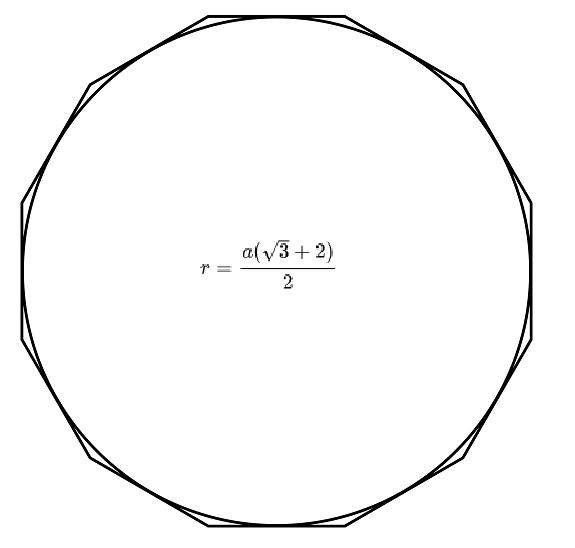
3. Case #3 – dodecadon on a circle.
A dodecadon has 12 sides, so twice as many as in a hexagon.
Just looking at the picture above is enough to realise that the approximation for the angle of 30 degrees will be MUCH better!
We know that r is equal to 57 meters, so we can calculate a:
a = 57 meters * 2 / (1.732 + 2) = 30.55
Obviously the perimeter of the dodecadon is 366.60 meters (12 * 30.55 meters).
It's 102% of the length of the wall of the silo (366.60 meters / 360 meters = 1.0183).
The error is ONLY 2% in the full circle, so it's a FANTASTIC approximation!!! So, we can consider that 1 meter of the perimeter of the dodecadon is a fantastic approximation of 1 degree!!!
We have a non-regular triangle with the bottom side of 30.55 meters, that represents 30 degrees, BUT the distance to the crucial line is 57 meters! We want to calculate the FOV-m at 1000 meters, so we have to convert 57 meters to 1000 meters (1000/57). And we get the same formulas!
FOV-m = FOV-deg * 1000/57
FOV-deg = FOV-m * 57/1000
Magic number 57.
My approximation in the small triangle (before conversion) was 1 meter for 1 degree (assuming the 2% error), so after conversion the FOV-m for the angle of 30 degrees is equal to:
FOV-m= 30 * 1000/57 = 526.32 meters at 1000 meters
The precise FOV-m for the angle of 30 degrees is this:
FOV-m-precise = 30.55 * 1000/57 = 533.96 meters at 1000 meters.
Obviously the smaller the angle the better the approximation.
On some Internet site I found a calculator that calculates FOV-m from FOV-deg that uses the tangent function, but this is a much WORSE approximation!
FOV of 60 degrees is converted to 1732.05 meters at 1000 meters !?!?!?!?!?
The error on that Internet site for this angle is 50% (1732.04 / 1154.74 = 1.500) !?!?!?!?!?
In my approximation the error for the angle of 60 degrees was “only” 10%.
With smaller angles the error on that Internet site gets smaller, but it's still much bigger than the error in my approximation, for example:
FOV of 30 degrees is converted to 577.35 meters at 1000 meters.
The error on that Internet site for this angle is still quite significant: 8% (577.35 / 533.96 = 1.081), while the error in my approximation is only 2%!
Please notice that human eyes have different FOV for different purposes, but everything above 60 degrees is usually considered peripheral vision.
Please notice that the magic number 57 is true not only in the metric system, but also in the yard system! For example 1 degree is given as 52.5 feet at 1000 yards:
1 degree = 52.5 feet at 3000 feet
3000 feet / 52.5 feet = 57.1429
HOWEVER the formulas have to be slightly different:
FOV-f = FOV-deg * 1000*3/57
FOV-deg = FOV-f * 57/1000/3
Let's analyse a real examples of binoculars: Binoculars Nikon Aculon 8x42 (8.0 deg or 420f/1000y):
FOV-f = 8.0 * 1000*3/57 = 421.053
FOV-deg = 420 * 57/1000/3 = 7.980
(Originally posted on Friday, 11 November 2016; expanded on 14 November 2016)
I am currently re-reading (once again) an awesome novel by Joe Haldeman titled “The Forever War”. I am going to review it in detail, but here I would like to mention that time dilation plays an important role in the plot of this novel. It made me ponder on the main aspects of Albert Einstein’s special theory of relativity again. Some of the things I found on the net were truly jaw-dropping and I decided to analyse this topic in detail.
This time I realised that to fully understand Albert Einstein’s special theory of relativity you have to simultaneously analyse three different things that change when travelling at speeds close to the speed of light: time, length and mass. What’s worse these three things can be seen from two different perspectives and it seems that some internet sites switch the perspectives back and forth, which is utterly confusing.
First, I have to comment on the “change of mass”. It's a concept that is a kind of simplification, but mass is something we understand by heart and this is why I use it here. The point of special theory of relativity is that anything with non-zero mass can NEVER be accelerated to the speed of light – the more the speed of a spaceship approaches the speed of light the harder it is to keep the spaceship accelerating. On the Earth (with speeds much lower that the speed of light) the acceleration is harder when a particular thing (a car for example) is heavier and this is why we can imagine that when the speed of the spaceship approaches the speed of light the spaceship is much “heavier” than normal and we need a much more powerful engine to keep it accelerating in the same way. Finally, with the speed VERY close to the speed of light, the “mass” of the spaceship would go towards infinity and we would need and infinite engine power to keep it accelerating at all. We can also look at this problem from another point of view. When we have a particular space engine and we use it at its maximum power then the more the speed of the spaceship approaches the speed of light the slower the spaceship will be accelerating (the force coming from the engine stays the same, but the mass of the spaceship gets bigger and bigger). This is the only thing that is messed up in The Forever War, but ONLY at ONE moment.
Example I (“twins”)
The most famous example of how the special theory of relativity works is the example about twins – one twin stays on the Earth and the other one travels on a spaceship and comes back after some time. The twin who was on the Earth will be older then the twin who was on the spaceship. For the sake of the example below (for the sake of easy calculations) I assume that the spaceship accelerates and decelerates “almost instantly”, which in reality is not possible. I skip the acceleration/deceleration process because otherwise I would have to use Einstein’s general theory of relativity, which would be much more complicated.
Let’s assume that the spaceship (with the moving twin) travels to a star that is exactly 1 light-year away and then comes back, so the total distance is 2 light-years, and the speed of the spaceship is 0.9 times the speed of light (0.9c). The formula for relativistic factor (Lorentz factor), which calculates the changes of time, length and mass, is this:
The relativistic factor for the assumed speed of the spaceship is 2.294. Below there are two different versions of calculations that show what exactly happens from each perspective. Lengths and masses “are different” while moving, but they “come back” to normal at the end of the journey. The time on the other hand does NOT ”come back” to normal because the time had already passed.
Example I (“twins”) – version 1 of the calculations.
Observer: the stationary twin (the twin on the Earth).
Reference point (for the speed of the moving twin): the Earth.
I.1.a. Distance of the journey (length seen in the same way): 2 light years (unchanged distance/length).
I.1.b. Length of the spaceship (length seen in a different way): normal length of the spaceship / 2.294 = 0.4359 times the normal length of spaceship (irrelevant value).
I.1.c. Time of the journey: 2 light-years / 0.9c = 2.2222 years (time on the Earth).
1d. Mass of the spaceship: normal mass of the spaceship? (there’s no way to measure the mass of the spaceship from the Earth, but it's irrelevant – anyone outside the spaceship doesn't really care about its mass).
Example I (“twins”) – version 2 of the calculations.
Observer: the moving twin (the twin on the spaceship).
Reference point (for the speed of the moving twin): the Earth.
I.2.a. Distance of the journey (length seen in a different way): 2 light years / 2.294 = 0.8718 light-years.
I.2.b. Length of the spaceship (length seen in the same way): normal length of the spaceship (unchanged length).
I.2.c. Time of the journey: 0.8718 light-years / 0.9c = 0.9687 years (time on the spaceship).
I.2.d. Mass of the spaceship: normal mass of the spaceship * 2.294 = 2.294 times the normal mass of the spaceship (more than twice as “heavy”, but still able to accelerate further in a decent way).
Example I (“twins”) – time comparison.
I.3. One day/month/year on the spaceship was equal to 2.294 days/months/years on the Earth (2.2222 years on the Earth / 0.9687 years on the spaceship).
Example I (“twins”) – interesting things to notice and explain.
4a. The LENGTHS changed for BOTH observers by the same factor, but different things changed (temporarily) for different observers. To the stationary twin it was the length of the spaceship that changed (everything else was stationary to him) and to the twin on the spaceship it was everything other than spaceship that changed (only the spaceship was stationary to him). The reference point (the real stationary point in the example) was the Earth because it was the Earth that was NOT accelerating or decelerating (except for its journey around the sun, but the solar system as a whole can be considered as a stationary point, more or less).
4b. It took 0.9687 years on the spaceship to travel a distance that the light itself travels for 2 years. How is that possible?
The problem is that both these times are given by different observers. The time of 2 years is given by the observer who is watching the LIGHT from the Earth and the time of 0.9687 years on the spaceship is given by the observer who is watching the SPACESHIP from the “inside”. As we can see in the above example for the “outside” observer the time of the journey of the spaceship is 2.2222 years on Earth, which is MORE than 2 years (the time of the journey of the light), so for the single “outside” observer everything is OK. The funny question is what time would be given from the perspective of the light itself. The answer is jaw-dropping: ZERO!!! For example if a spaceship would reach 0.99999999999999 times the speed of light (there are 14 “9”) then the relativistic factor would be 7073895.381! It means that one day/month/year on the spaceship would be equal to 7073895.381 days/months/years on the Earth! Of course it will never be possible to reach such a high speed because it would also mean that the mass of the spaceship would be 7073895.381 times the normal mass of the spaceship – there would be no way to generate enough force to accelerate such a “heavy” monster.
4c. What was the ONLY problem with Forever War?
This one fragment is dubious: “It's not as though we'd be actually lost,” he said with a rather wicked expression. “We could zip up in the tanks, aim for Earth and blast away at full power. We'd get there in about three months, ship time.”
“Sure,” I said. “But 150,000 years in the future.” At twenty-five gees, you get to nine-tenths the speed of light in less than a month. From then on, you're in the arms of Saint Albert.
The way it is written it is clear that a 3 month journey from the spaceship perspective would mean 150,000 Earth-years. The AVERAGE relativistic factor would have to be 600,000 (150,000 years on the Earth / 0.25 years on the spaceship), but it would mean that the mass of the spaceship would be 600,000 times its normal mass. No way I could imagine an engine technology that would succeed to speed up such a “heavy” spaceship. Thankfully in other parts of the book there were no such horrendously high relativistic factors.
By the way: the relativistic factor of 600,000 is “achieved” by the speed of 0.9999999999986111c (on one of the sites given below you can find an online calculator that allows you, among other things, to do such reverse calculations in a very easy way).
4d. The twins paradox is explained by a different HISTORY of acceleration/deceleration.
The twins paradox is an example of a wrong application of the special theory of relativity. Somebody argued that from the point of view of the spaceship it was the Earth that was moving so BOTH twins should age in the same way. Some other people thought that the twins paradox is explained by the sheer acceleration/deceleration PROCESS, but it's not the case either. It's the different HISTORY of accelerations and decelerations that matters. The spaceship HAD to decelerate and accelerate to change the direction (to be able to come back to the starting point) and the Earth did not accelerate at all (except for its journey around the sun, but the solar system can be considered as an inertial system as a whole). Please notice that the accelerations and decelerations for the sake of the example were “almost instant”, but they were enough to determine which twin “was moving”. The scope of the time dilatation depends heavily on the speed of the spaceship and the length of the journey, NOT on the duration of the accelerations or decelerations alone. Below there is a fantastic visualization of the twin paradox (the Minkowski diagram of the twin paradox). The dots may be interpreted as the passing years (6 years for the travelling twin and definitely more years for the stationary twin – there are some dots missing for the stationary twin).
On a side note: I found also a fantastic visualization of an accelerating observer in special relativity:
I analysed another example of how the special theory of relativity works. One of the crucial questions is: “What would happen if 2 spaceships (A and B) were going in opposite directions at very high speeds?” I added a special twist and placed the stationery observer (the observer on the Earth) between the spaceships, which makes my example much more interesting. To make the example easier (to makes some of the calculations similar to the previous example) I assumed that each spaceship is 2 light-years away from the Earth (so they are 4 light-years away from each other) and that the speed of each spaceship is 0.9c relative to the Earth:
Example II (“three observers”) – version 1 of the calculations.
Observer: the stationary observer (the observer on the Earth).
Reference point (for ALL the speeds involved): the Earth.
II.1.a. Distance of the journey of each of the spaceships: 2 light years.
II.1.b. Length of each of the spaceship: … (irrelevant value).
II.1.c. Time of the journey: 2 light-years / 0.9c = 2.2222 years (time on the Earth).
II.1.d. Mass of the spaceship: normal mass of the spaceship? (there’s no way to measure the mass of the spaceship from the Earth, but it's irrelevant – anyone outside the spaceship doesn't really care about its mass).
Example II (“three observers”) – version 2 of the calculations (the same calculations are true for each of the spaceships).
Observer: the observer on the spaceship A (one of the moving observers).
Reference point (for ALL the speeds involved): the Earth.
II.2.0.a. Speed relative to the spaceship B: 0.994475c (this speed can actually be measured by the observer on the spaceship A, but it is NOT relative to the Earth).
The moving observer sees not only the Earth, but he also sees the other moving spaceship almost exactly in the same line as he sees the Earth (not exactly in the same line, so it is not obscured by the Earth). According to the special theory of relativity the formula for the speed addition is this:
Please notice that if the speed “u” were 0 then the sum of the speeds (“s”) would be equal to the speed “v”. In our example v=0.9c and u=0.9c, so s=0.994475c. It means that the moving observer would measure this speed relative to the other spaceship. In other words: the moving observer sees the Earth “approaching” at the speed of 0.9c and next to it he sees the other spaceship “approaching” at the speed of 0.994475c.
II.2.0.b. Speed of the other spaceship relative to the Earth: 0.994475c – 0.9c = 0.094475c (the observer on the spaceship sees this speed this way).
II.2.0.c. CALCULATED (real) speed of the other spaceship relative to the Earth: 0.9c.
If the moving observer knows the special theory of relativity he can use the above formula for the speed addition and calculate the third speed “in reverse”. It means that from the formula he would know “v” (his speed relative to the Earth) and “s” (his speed relative to the other spaceship), so he would be able to calculate “u” (the real speed of the other spaceship relative to the Earth) as being equal to 0.9c. He can't observe it directly, but he can calculate it.
II.2.0.d. Relativistic factor for the speed of 0.9c is 2.294 (we know that from the previous example).
II.2.0.e. Relativistic factor for the speed of 0.994475c is 9.526 (you can calculate it using the formula from the previous example).
II.2.a.1. Distance of the journey to the Earth: 2 light years / 2.294 = 0.8718 light-years (we know that distance from the previous example – see the point I.2.a.).
II.2.a.2.a. Distance of the journey to the other spaceship NOT relative to the Earth: 4 light-years / 9.526 = 0.4199 light-years (distance NOT relative to the Earth but to the other spaceship).
II.2.a.2.b. Distance of the journey to the other spaceship relative to the Earth: 0.4199 light-years * 2.294 = 0.9633 light-years (distance relative to the Earth).
II.2.a.3 Distance between the other spaceship and the Earth: 0.9633 light-years – 0.8718 light-years = 0.0915 light-years (distance relative to the Earth).
II.2.b. Length of each of the spaceship: … (irrelevant value).
II.2.c.1. Time of the journey to the Earth: 0.8718 light-years / 0.9c = 0.9687 years (time on the spaceship – we know that time from the previous example – see the point I.2.c.).
II.2.c.2.a. Time of the journey to the other spaceship NOT relative to the Earth: 0.4199 light-years / 0.994475c = 0.4222 years (time on the spaceship NOT relative to the Earth but to the other spaceship).
II.2.c.2.b. Time of the journey to the other spaceship relative to the Earth: 0.4222 years * 2.294 = 0.9685 years (time on the spaceship relative to the Earth).
II.2.c.3. Time of the journey of the other spaceship to the Earth: 0.0915 light-years / 0.094475c = 0.9685 (time on the spaceship relative to the Earth).
All the times of the journeys (II.2.c.1., II.2.c.2.b. and II.2.c.3.) are the same! The values 0.9687 and 0.9685 are not exactly equal because I rounded all the numbers to 3 or 4 decimal places and several steps in calculations caused this minute difference (0.0002). Anyway, it means that each journey (the spaceship A to the Earth, the spaceship A to the spaceship B and the spaceship B to the Earth) will last equally long, so all the observers will meet at the Earth at the same time – exactly as it was calculated by the stationary observer (the observer on the Earth).
II.2.d.1. Mass of the spaceship relative to the Earth: normal mass of the spaceship * 2.294 = 2.294 times the normal mass of the spaceship (more than twice as “heavy”, but still able to accelerate further in a decent way).
II.2.d.2. Mass of the spaceship relative to the other spaceship: normal mass of the spaceship * 9.526 = 9.526 times the normal mass of the spaceship (almost 10 times as “heavy” – significantly more difficult to accelerate).
Please notice that the change of mass depends on the observer AND on the reference point. The mass of the spaceship AT THE SAME TIME/PLACE seems lower (when looking at the Earth) or bigger (when looking at the other spaceship). The mass is relative too! This example “proves” that it's not really a physical change in mass, but it’s more like “it seems that the spaceships mass is higher because we can't accelerate it as well as we did at lower speeds”. The higher the OBSERVED speed the bigger the “FEELING” that the mass of the spaceship is higher.
As you can see from the above calculations you have to be very careful to use the same observer AND the same reference point for ALL the final calculations! It is very easy to mess things up by joining calculations made for different observers OR with different reference points!
Example II (“three observers”) – time comparison.
II.3. One day/month/year on the spaceship was equal to 2.294 days/months/years on the Earth (2.2222 years on the Earth / 0.9687 years on the spaceship).
The calculations can be also made for a different reference point – for example we could assume that the spaceship B is stationary and both the other spaceship A and the Earth were moving (or instead of the Earth there could be just another spaceship). It would mean that the Earth is “running away” from the spaceship A (that the Earth is going in the same direction as the spaceship A). This time the speed of the spaceship A relative to the spaceship B (0.994475c) would be the speed “v” and the speed of the spaceship A relative to the Earth (0.9c) would be the speed “s” (the sum of speeds). The speed “u” (the speed of the Earth relative to the spaceship B) would be equal to -0.9c (the negative number means that the speed is not added, but subtracted from the speed 0.994475c).
Once again: this is exactly the same example, but with the REFERENCE POINT being the spaceship B (not the Earth). Let's calculate things from the POINT OF VIEW of the spaceship A.
Example II (“three observers”) – version 3 of the calculations.
Observer: the observer on the spaceship A.
Reference point (for ALL the speeds involved): the spaceship B.
II.3.0.a. Speed relative to the Earth: 0.9c (this speed can actually be measured by the observer on the spaceship A, but it is NOT relative to the spaceship B).
II.3.0.b. Speed of the Earth relative to the spaceship B: 0.994475c – 0.9c = 0.094475c (the observer on the spaceship A sees this speed this way).
II.3.0.c. CALCULATED (real) speed of the Earth relative to the spaceship B: -0.9c (the “-“ sign determines only the direction of the movement – the same direction as the spaceship A). The observer on the spaceship A can't observe it directly, but he can calculate it.
II.3.0.d. Relativistic factor for the speed of -0.9c is 2.294 (we know that from the example I – the direction of the movement is not important).
II.3.0.e. Relativistic factor for the speed of 0.994475c is 9.526 (we know that from the example II).
II.3.a.1. Distance of the journey to the spaceship B: 4 light-years / 9.526 = 0.4199 light-years (relative to the spaceship B).
II.3.a.2.a. Distance of the journey to the Earth NOT relative to the spaceship B: 2 light-years / 2.294 = 0.8718 light-years (distance NOT relative to the spaceship B but to the Earth).
II.3.a.2.b. Distance of the journey to the Earth relative to the spaceship B: 0.8718 light-years / 2.294 = 0.3800 light-years (distance relative to the spaceship B).
II.3.a.3 Distance between the Earth and the spaceship B: light-years 0.4199 – 0.3800 light-years = 0.0399 light-years (distance relative to the spaceship B).
II.3.b. Length of each of the spaceship: … (irrelevant value).
II.3.c.1. Time of the journey to the spaceship B: 0.4199 light-years / 0.994475c = 0.4222 years (time on the spaceship A).
II.3.c.2.a. Time of the journey to the Earth NOT relative to the spaceship B: 0.8718 light-years / 0.9c = 0.9687 years (time on the spaceship A NOT relative to the spaceship B but to the Earth).
II.3.c.2.b. Time of the journey to the Earth relative to the spaceship B: 0.9687 years / 2.294 = 0.4223 years (time on the spaceship A relative to the spaceship B).
II.3.c.3. Time of the journey of the Earth to the spaceship B: 0.0399 light-years / 0.094475c = 0.4223 (time on Earth relative to the spaceship B).
All the times of the journeys (II.3.c.1., II.3.c.2.b. and II.3.c.3.) are the same! The values 0.4222 and 0.4223 are not exactly equal because I rounded all the numbers to 3 or 4 decimal places and several steps in calculations caused this minute difference (0.0001). Anyway, it means that each journey (the spaceship A to the Earth, the spaceship A to the spaceship B and the Earth to the spaceship B) will last equally long, so all the observers will be at the Earth at the same time – exactly as it was calculated with a different reference point (the Earth in the previous 2 variations of the calculations).
II.3.d.1. Mass of the spaceship relative to the Earth: normal mass of the spaceship * 2.294 = 2.294 times the normal mass of the spaceship (more than twice as “heavy”, but still able to accelerate further in a decent way).
II.3.d.2. Mass of the spaceship relative to the other spaceship: normal mass of the spaceship * 9.526 = 9.526 times the normal mass of the spaceship (almost 10 times as “heavy” – significantly more difficult to accelerate).
Example II (“three observers”) – time comparison #2 (different values for different reference points).
Before we can compare anything we have to calculate time of journey from the point of view of the spaceship B:
II.3.0. Time of the journey of the spaceship A: 4 light-years / 0.994475c = 4.0222 years (time on the spaceship B).
II.3. One day/month/year on the spaceship A was equal to 9.527 days/months/years on the spaceship B (4.0222 years on the spaceship B / 0.4222 years on the spaceship A).
We could do the calculations for the “moving Earth” because in the above example NEITHER observer accelerated, so ANY reference point was equally good. However, if we analysed a “triplets” example (all the observers are triplets – one stays on the Earth and the other 2 triplets depart the Earth in opposite directions, travel at the same speed the same distance and then come back to Earth also travelling at the same speed) then there could be only 1 correct reference point – the Earth. Only the Earth was NOT accelerating or decelerating – the other 2 triplets were accelerating and decelerating to change their direction (to be able to come back to the starting point). The Minkowski diagram of the triplets paradox would look like this:
I was inspired to create this post by a great French animated series that in English is called “Once Upon a Time – The Discoverers”: https://en.wikipedia.org/wiki/Once_Upon_a_Time..._The_Discoverers
The Polish DVD box set (6 DVDs containing 26 episodes) looks like this:
Currently we (me, my wife and our children) watch this series and my 10-year-old daughter loves it because she can learn about many interesting things that she didn't know before. However, because it's a series for children some things are only described as fun facts, but not really explained.
For example my daughter was VERY surprised that a big (heavy) stone would fall down in the same time as a small (light) stone dropped from the same height at the same moment. This fact was shown in the episode about Galileo. I like physics very much, so I stopped the episode there and added another trivia – I told my daughter that in vacuum (without air resistance) a feather would fall down also in the same time. She couldn't believe it. The problem is that this fact (about the falling stones) was not really explained. The very next episode about Newton described among other things Newton's law of universal gravitation, which actually makes the case of the falling stones even less intuitive.
Please remember that all the pictures below are NOT to scale! Either the effects are overstated (to be visible) or the distances between orbiting moons/planets are shortened (to be visible on a small picture). I found most of the pictures on the net, but I modified some of them and I made some other totally by myself.
1. Gravity and acceleration.
Newton's law of universal gravitation is this:
F is the force between the masses,
G is the gravitational constant,
m1 is the first mass (for example the Earth),
m2 is the second mass (for example a stone),
r is the distance between the centers of the masses.
The formula is clear – the force of gravity is actually bigger when the mass of the stone is bigger, so why all the stones should fall with the same acceleration? The answer is: because a bigger (heavier) stone is harder to move than a smaller (lighter) stone. The formula for acceleration is this:
So, by combining the formula for acceleration for the mass of a stone (m2) with the formula for the force of gravity between the Earth (m1) and the stone (m2) we get this formula for the acceleration of the stone:
The acceleration of the stone (or of any other object) caused by the Earth depends only on the mass of the Earth (which doesn't change) and the distance between the Earth and the accelerated object.
BUT there is an additional catch – the force of gravity works both ways. It means that a stone accelerates towards the Earth and the Earth accelerates towards the stone, so the formula for the total acceleration is this:
The mass of a stone that weighs 1kg is 5972200000000000000000000 times smaller than the mass of the Earth, so the acceleration of the Earth toward the stone is undetectable. This is why the gravitational acceleration of “normal” objects depends ONLY on the mass of the Earth and this is why stones of different weights fall to Earth with the same acceleration.
However with more massive objects, like the Moon, the above formula becomes very important. Well, the formula would work directly only if the Moon were falling directly to the Earth. But in reality the Moon “orbits” the Earth, so what the above formula really means? It means that both the Moon and the Earth orbit their barycenter (the center of mass of two or more bodies). The barycenter of the Earth and the Moon is actually located within the Earth, but NOT at the center of the Earth. Here's a GIF showing how the Moon and the Earth orbit their barycenter:
2. Centrifugal force.
The next natural question is “why the Moon is not falling to the Earth”? This question was actually “explained” in the episode about Newton (that comes right after the episode about Galileo), but the “explanation” didn't really explain anything. The “explanation” was “The Moon is not falling to the Earth because of the centrifugal force that exists because the Moon orbits the Earth.” Oh, boy. In other words the “explanation” was this: “The Moon is not falling to the Earth because it orbits the Earth”. Obviously there is another question: “Why does the Moon orbit the Earth?”
Interestingly, the correct answer is kind of ironic: The Moon “orbits” the Earth (“the Moon is not falling to the Earth”) because the Moon keeps “falling” behind the horizon of the Earth. Imagine yourself throwing a stone in vacuum (without air resistance). A weak throw would give the stone low velocity (speed plus its vector) and the stone would fall to the ground close to you. A stronger throw would give the stone higher velocity and the stone would fall to the ground much farther. Throwing a stone with enough force would give the stone enough velocity to keep falling behind the horizon (to orbit the Earth). Even stronger throw would actually be enough to escape from the gravitational influence of the Earth.
This explains that the centrifugal force depends on the velocity. On the picture below you have a “down-to-Earth” example – a person holds an object on a string:
If the speed of the object were too low there would be not enough centrifugal force and the object would not rotate around the person in the air but it would be dragged on the ground (in space the Moon would fall to the Earth). If the speed of the object were too high the string would break and the object would fly away from the person (in space the Moon would escape from the gravitational influence of the Earth). Only if the speed were not too low and not too high the object would rotate around the person in the air without breaking the string (in space the Moon would “orbit” the Earth because the force of gravity and the centrifugal force would be equal). Please remember that the Moon and the Earth actually orbit their barycenter, so there would be two centrifugal forces – one for the Moon and the other for the Earth. I'll get back to this issue later (in part 3 about tides).
Please notice that not only the velocity has to be right (not too low and not too high), but also its vector has to be right. However, the vector of the velocity doesn't have to be perpendicular to the vector of the gravity force all the time (like in the example with the object on a string). In fact most of the orbits of the objects in space are elliptical. Here's an example of extremely elliptical orbits around a barycenter:
The orbits of The Moon and the Earth around their barycenter are elliptical too, but to a much lesser extent. However, their elliptical orbits are significant enough to make the difference between a total solar eclipse and an annular solar eclipse.
Summing up: The centrifugal force is sometimes called fictitious/pseudo force because it acts on masses whose motion is described using a non-inertial frame of reference – in this case a rotating frame of reference:
An example of a non-rotating non-inertial frame of reference would be a bus that is breaking (slowing down). The force that “pushes” the passengers towards the front of the bus is a counterpart of the centrifugal force in a rotating frame of reference. As I described above (the part about thrown stones) the same effect can be explained by sheer acceleration and velocity while “looking from the outside.” Here's a GIF:
To understand how it works you have to realise that acceleration CHANGES velocity, but not necessarily increases speed. Velocity is speed plus its vector, not speed alone. In case of orbiting objects acceleration changes mostly the VECTOR of the speed. Well, in case of a perfectly circular orbit the acceleration changes ONLY the vector of the speed, but in case of an elliptical orbit the acceleration changes mostly the vector of the speed and to lesser extent the speed itself (the speed increases when close to the barycenter, but decreases when away from the barycenter).
Interestingly, the force of gravity itself can also be seen as a fictitious/pseudo force, but it's quite complicated because it concerns curved spacetime. I will describe it in the point 4, but first let's take a look at something that is clearly visible in our world – tides.
3. Tides.
Tides are the result of the gravity of the Moon and to lesser extent of the gravity of the Sun. We could also say that tides are the result of Earth's acceleration around Moon-Earth barycenter and to lesser extent of Earth's acceleration around Sun-Earth barycenter.
First, let's understand why the gravity of the Earth doesn't cause tides on its own. The gravity of the Earth is more or less the same, so the acceleration all over the Earth is more or less the same. The only difference is the fact that the centrifugal force of the rotating Earth is slightly counteracting the gravity of the Earth, but the centrifugal force is strongest at the equator:
So the gravity at the equator is slightly lower than it is at the geographical poles. It can be compared to a child's toy ball that you squeeze with your hands, putting one hand at the top and the other at the bottom. This fact explains why the Earth is a little flattened:
The point is that the Earth is constantly rotating, so it's constantly flattened. Interestingly the Earth is constantly flattened both as a solid rock and as a mass of water. It means that some oceans are deeper than the other, but we don't see it because all the depths don't change over time because of Earth's rotation:
A very important question is this: “If here is a centrifugal force, then why all the oceans don't fly away into space?” Because the centrifugal force is very weak when compared to the force of gravity, so the centrifugal force can only slightly deform the Earth (both as a solid rock and as a mass of water). The gravity holds everything together, but this “everything” exists in a slightly flattened form caused by the centrifugal force. It can be compared to a child's toy ball that you squeeze with your hands, but the toy ball doesn't break just because you squeeze it.
So, there would be no tides without the Moon and without the Sun. But how the Moon or the Sun cause tides on the Earth? There are two explanations based either on accelerations and velocity or on the gravity and the centrifugal force. Let's start with accelerations because it's more fun and less intuitive.
3a. Tides explain by accelerations and velocity.
Let's imagine the Earth and the Moon are getting closer to each other (there is no orbit at all, but the Earth is still rotating around its axis of rotation, so the tides caused by the Moon are real). Please remember that the pictures below show only the real tides (they now ignore the different depths of ocean's caused by the centrifugal force that were shown on the previous picture). Please, notice also that the Earth's axis of rotation is tilted to the Moon's orbit plane. On the pictures below I omitted the acceleration of the Moon caused by the Earth, because there are no oceans on the Moon, so there are no tides there:
The ocean that is (at a particular moment) on the right side of the Earth is closer to the Moon than the center of the Earth and the center of the Earth is (at a particular moment) closer to the Moon than the ocean on the left side of the Earth. As I described earlier the acceleration of any object caused by the Moon depends only on the mass of the Moon (which doesn't change) and the distance between the Moon and the accelerated object. So the accelerations are different for the “right” ocean, the center of the Earth and the “left” ocean.
Because of the differences in accelerations the “right” ocean is getting closer to the Moon more quickly than the other parts of the Earth, so its acceleration is getting more and more bigger than the other accelerations, which stretches the oceans more and more with every second:
The example above shows that tides are all about accelerations, but in reality the Earth and the Moon are NOT getting closer to each other, but orbit their barycenter. So, how tides actually work? I have to repeat again: acceleration CHANGES velocity, but not necessarily increases speed. Velocity is speed plus its vector, not speed alone. In case of orbiting objects acceleration changes mostly the VECTOR of the speed.
At a particular moment the speed of the Earth around the Earth-Moon barycenter is the same for all its parts. Why? Because the Earth doesn't ROTATE around the barycenter (the Earth rotates only around its own axis of rotation), but instead the Earth moves through space (around the barycenter) as one solid object. This object (the solid rock plus the mass of water) is held together by the acceleration caused by the Earth (by its mass). The acceleration caused by the Moon is very weak when compared to the acceleration caused by the Earth, so the acceleration caused by the Moon can only slightly deform the acceleration caused by the Earth. Obviously this effect is strongest when the Earth, the Moon and the ocean are in the same line, so in the parts of the Earth that are farther away from the Earth-Moon line the effect is weaker. It slightly deforms the Earth in the Earth-Moon line (mostly the mass of water on the surface of the solid rock). It can be compared to a cherry (with the stone still inside) that you squeeze with your fingers. The cherry can be slightly squeezed, but it doesn't break just because you squeeze it AND you can't squeeze the stone inside. On the picture below I omitted the acceleration of the Moon caused by the Earth, because there are no oceans on the Moon, so there are no tides:
So, the same velocity is changed by different accelerations working at different distances away from the Moon. The formula for the centripetal acceleration is this:
So, with the same velocity and different accelerations the radii HAVE to be different. The “right” ocean has a higher acceleration, so its radius is smaller. The “left” ocean has the smallest acceleration, so its radius is the biggest. As I said earlier – everything is held together by the acceleration caused by the Earth, only slightly deformed by the acceleration caused by the Moon.
As the Earth rotates around its own axis of rotation, different oceans become “right” or “left” oceans, so over time different oceans are stretched towards or away from the Moon. Standing at a particular place at the edge of a particular ocean we see it as tides, coming and going.
3b. Tides explained by the gravity and the centrifugal force.
The explanation for tides based the gravity and the centrifugal force is more intuitive, except for one thing – the direction of the centrifugal force is the same for all parts of the Earth (exactly like velocity), even though the Earth-Moon barycenter is located within the Earth. The reason is exactly the same – the Earth doesn't ROTATE around the barycenter (the Earth rotates only around its own axis of rotation), but instead the Earth moves through space (around the barycenter) as one solid object. This object (the solid rock plus the mass of water) is held together by the Earth's gravity. The gravity of the Moon is very weak when compared to the gravity of the Earth, so the gravity of the Moon can only slightly deform the gravity of the Earth. Obviously this effect is strongest when the Earth, the Moon and the ocean are in the same line, so in the parts of the Earth that are farther away from the Earth-Moon line the effect is weaker. It slightly deforms the Earth in the Earth-Moon line (mostly the mass of water on the surface of the solid rock). It can be compared to a cherry (with the stone still inside) that you squeeze with your fingers. The cherry can be slightly squeezed, but it doesn't break just because you squeeze it AND you can't squeeze the stone inside.
We know that the Earth is orbiting the Earth-Moon barycenter, so in the middle of the Earth the centrifugal force is equal to the Moon's force of gravity. Let's see how it looks at the oceans:
Here's a biger picture (click to enlarge):
The point is that the force of gravity is stronger when the object is closer to the mass. The “right” ocean is closer to the Moon and the “left” ocean is farther away from the Moon. Because the centrifugal force is the same for all parts of the Earth, there are small differences (red arrows) at the opposite sides of the Earth, pointing in different directions. These are the forces that stretch the Earth (mostly the mass of water on the surface of the solid rock). As I said earlier – everything is held together by the gravity of the Earth, only slightly deformed by the gravity of the Moon.
4. Spacetime.
To understand why the force of gravity itself can be seen as a fictitious/pseudo force we have to understand the concept of spacetime – the three dimensions of space combined with the one dimension of time. Without any mass the spacetime can be imagined as a flat surface. Any non-zero mass curves spacetime and the force of gravity is just a result of the curved spacetime:
Please, notice that both the Earth and the Moon curve the spacetime (it reflects the fact that there are two forces of gravity – two accelerations).
The concept of curved spacetime came with the general theory of relativity (published by Albert Einstein in 1915) that had some spectacular predictions. One of them was the prediction that light itself should be “deflected”. A 1919 expedition led by Eddington confirmed general relativity's prediction for the “deflection” of starlight by the Sun during the total solar eclipse of May 29, 1919, making Einstein instantly famous. It can bee imagined like this:
The yellow line is the real path of the light and the red dashed line is the apparent position of the star. The apparent position is known to be wrong because it doesn't match the position of the star when looking from the Earth without the sun being in the way.
Please, notice that light doesn't actually bend – it is the spacetime that is bent. Light always travels in a straight line. Below there is another picture with an additional yellow line that is also STRAIGHT (in the curved spacetime):
Somebody could ask: “If the yellow lines are straight (in spacetime) then any space object (for example a comet) should go the same paths, right?” Wrong. Light is massless, so it doesn't bend the spacetime on its own, but any object with non-zero mass curves the spacetime IN ADDITION to the curvature caused by the main mass – the straight line for the non-zero mass object passing close to a star would be different (more “bent”):
Please, notice that the beginning of the green path (of the non-zero mass object) was the same as the beginning of the yellow path (of light) – in the “flat” spacetime the straight line is the same for any object.
The line around the more massive object is also a straight line for the less massive object (when both masses curve the same part of the spacetime at the same time):
If an object's mass was big enough it would be a black hole – the spacetime around it would be so bent that the straight line for the massless light would actually “circle” the object:
Here's a great video showing why the gravity and the curved spacetime are the same:
What makes the concept of spacetime much more difficult to grasp is the fact that according to the general theory of relativity objects within an accelerating enclosure behave similarly to objects in a gravitational field. For example, an observer will see a ball fall the same way in a rocket as it does on the Earth, provided that the acceleration of the rocket is equal to the acceleration due to the gravity at the surface of the Earth:
In fact an observer would have no way of deciding if he is on the Earth or in a rocket, if he were placed in a closed room. OR an observer in a rocket would have no way of deciding if the rocket is accelerating in space or just standing on the Earth:
The opposite is also true – a person who were in an elevator cabin falling down the elevator shaft would feel weightless, similar to a person in space who is not accelerating:
Well, this is a kind of simplification because this “rule” is true only for a small elevator cabin. However, in a HUGE elevator cabin you could actually tell that you are not in space because you could you see that the falling objects are getting closer to each other (farther away from the walls):
I tried to find an example of how acceleration bends the spacetime, but I couldn't find even a SINGLE one! There are many examples of how mass bends the spacetime, but NO examples how acceleration bends spacetime. I imagine this process to be similar to a car accelerating on a muddy road. To make my example even more interesting I added a ball lying some distance behind the car. Here's the state before acceleration (the spacetime is “flat”):
When the car starts accelerating its wheels dig into the ground and move the ground behind the car. The car moves in one direction, but the ground piles up behind the car, so the red ball finds itself on a slope, which makes it roll downhill in the opposite direction than the car:
I have no idea if my example is correct, but it definitely makes some sense. The antigravity effects (the slopes ABOVE the “flat” spacetime) might explain the fact that the universe is expanding.
What kept bothering me, however, was the fact that a car accelerating on a muddy road would behave differently with different wheel drives (rear wheel drive, front wheel drive and 4x4 wheel drive). I wonder if this could be important in space when the acceleration would be big enough and the spaceship would be long enough. If that's the case then the spacetime together with the spaceship would bend differently with a “front wheel drive”:
The rear wheels would be rolling “uphill”, which would consume energy. So the most efficient way of designing a spaceship would be to add another pair of “wheels” and make it “6x6 wheel drive”:
AGAIN: these examples are only how I myself imagine the way acceleration bends the spacetime. I have no idea if this analogy is actually correct. But this theory of mine is kind of fascinating.
5. Time.
Even more surprising aspect of the general theory of relativity is the fact that time “slows down” near massive objects. It was actually verified experimentally. The effect is significant enough that the Global Positioning System's artificial satellites need to have their clocks corrected. But how it can be imagined? This is actually much more easy than I thought, but I had to make my own examples again – the examples on the Internet usually have “too flat a bottom”. The point of my examples is to show you that the spacetime is bent (or “stretched”) the most in the point closest to the mass.
The yellow dots may be seen (or heard) as ticks of a clock. In the “flat” spacetime the ticks are regular, but near the massive objects the pauses between the ticks are longer and longer. This is connected with the crucial assumption (both in the general theory of relativity, as well as in the special theory of relativity) that any observer (on any path) should measure the same speed of light.
If mass/acceleration would be big enough and the spaceship would be long enough the clocks inside the same spaceship would run differently. In the example with big rockets (one accelerating in space and one standing on the Earth) you can see two clocks (A and B) showing different times (in both rockets).
My thought experiment with the antigravity twist made me wonder if time would slow down in such places (“above the flat spacetime”) too. Logic says it would: